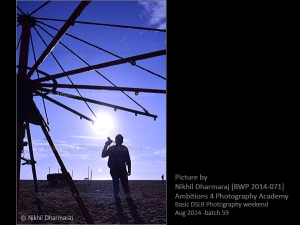
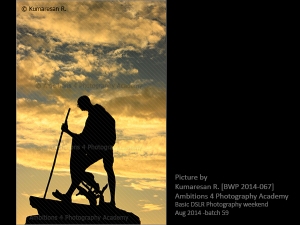
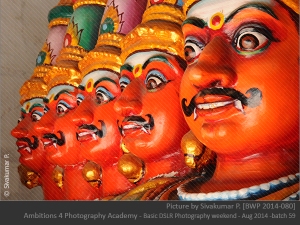
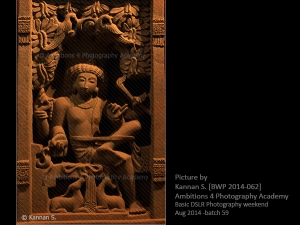
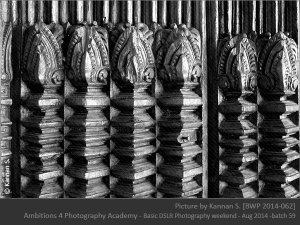
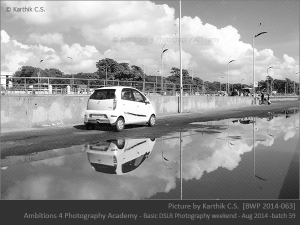
Basic DSLR Photography Weekend batch 59 started on the 9th of August
2014. Here are some of the pictures taken by the participants. The
images stand as an testimony of their Photography learning at Ambitions 4
Photography Academy. Many of the participants bought their first
Digital SLR only after joining the course. Well structured curriculum,
friendly and approachable mentor who can make the participants
understand the concepts easily, guided field-trips, review and feedback
all delivered with at-most professionalism makes the programme a big hit
among the participants. Ambitions 4 Photography Academy is very proud
to have been a part of each participants Photographic journey.
Friday, 14 November 2014
Wednesday, 10 September 2014
How to shoot a ‘Zoom Burst’ ?
Zoom burst is an effect created by shooting a picture while the zoom
ring is rotated. This gives a feel of radial blur – the middle part of
the frame is relatively sharp and clear whereas the edges of the frame
will take the blurring effect.
- This can be tried with both moving and still subjects. The still subject will give a feel of movement…!
- You can choose to use this technic on some dynamic subjects like automobiles or any other action prompting subjects. You can also use this on people when you want to make a special emphasis on to an individual leaving others behind in blur.
- Preferably use short zooms (18-55mm/24-70mm) for good effects of radial blur.
- Use zooming in or zooming out action for not more than 10 to 15mm range ie.You can zoom in from 18mm to 35mm or 24mm to 40mm. This will maintain clarity and sharpness in the middle of the frame.
- Use shutter speeds closer to 1/30, 1/45, 1/60 and rotate the zoom ring at variable speeds for getting a right effect.
- Check for the ideal exposure before trying the actual ‘Zoom burst’. A shutter priority exposure mode will be a good choice.
- Use AF servo in Canon or AFC in Nikon and continuous shooting mode for better results.
- If the camera is on a stable base or tripod, it will prevent the unnecessary hand shake while shooting still subjects.
- May be you can tilt the frame a bit for a dynamic feel.
- Avoid plain and flat backgrounds. Backgrounds with good colours and patterns are most ideal for zoom burst shots
Monday, 11 August 2014
Interactive session on 360 degree Panorama
| Mr. Stalin Ramesh - architectural photographer and alumni of Ambitions 4 Photography Academy, conducted an exclusive interactive and demo session on ‘360 degree Panorama VR’ for the Learners of Edexcel BTEC Level 5 HND Diploma in Photography on 21st March 2014 |
Thursday, 5 September 2013
SPIRIT Island
This photo had quite an adventurous and interesting back story to it. Spirit Island is an amazing site to visit late in the afternoon and into evening when the light starts to get soft and casts long shadows over the emerald green Lake Maligne. The one important key to this adventure is to make sure to find the tiny campground near this island while it is still light outside, otherwise you may have to paddle all the way to the end of the super long 22km, 350ft deep, 1 degree above zero lake (most likely without the aid of sunlight) Which is exactly what we had to do soon after this photo was captured!
Equipment: Nikon D800, 12-24 Nikkor
Wednesday, 7 August 2013
CAVE Paradise
An unusual view of a sea cave at night from within. Shooting very complex in its execution, and 'needed the complete immersion of my body to the upper body and the tripod in salt water. A targeted adjustment of artificial light while I took with Remote Control + self-timer to 10 seconds. Light soft for not overdoing the texture of the cave. Surreal environment also in the lived reality.
Equipment: Nikon D3s Nikkor 14/24mm
Wednesday, 3 July 2013
Friday, 7 June 2013
Photographing Landmarks
Finding the Perfect Angle in Photographing Landmarks?
World renowned tourist destinations are always going to be written about and discussed widely on the net; therefore, the images of these places are always going to be in popular demand too. The point is, everyone else knows this and is out there shooting away to glory. But a particular place might take on different characteristics during the course of a day. An image taken during one of these times will look and feel completely different to an image taken at the other end of the day. It is worth doing some research of the place you are visiting to find out what the most suitable time is to go about shooting it. Maybe Summer? Autumn? During daylight or moonlight? There is precisely why professional photographers spend days, or weeks, together at a particular location. Precisely that is the reason why they try to capture its many splendors, moods and personalities. But for the average traveler with the intentions of capturing memories of their big trip, it’s all about capturing their experience. Irrespective of what level your photography is at, with a little effort spent in research and planning, and a thoughtful approach to creating images, it is possible for anyone to take that one shot that stands out from the rest. And the answer is to simply think outside the box!
Friday, 10 May 2013
Storing your Equipments
Storing Your Camera/Equipments
The Camera and other valuable equipments should be stored in enclosed areas such as the camera bag or the digicabinet thus preventing moisture, dust and grime from damaging them. Placing Packets of silica gel around the stored equipment acts as a boon since the silica gel absorbs all the moisture and vapours thus protecting the valuable. The best part about silica gel is that it can be reused again and again by reactivating it at regular intervals by heating it in the oven. (More on that in the next ‘did you know’)
Storing Wires
One of the most useful part of equipments are the cords and wires that we take for granted, but they literally for the nervous system of our photography! Be it the power cords or the Pc chords etc. One should store them by winding them into overlapping circles of approximately equal diameter. The bigger the circle (in context of its ratio with the length of the wire), the better it is as it makes the wire bend lesser, thus reducing the chances of internal breakage & wear and tear.
Storing Batteries
The Batteries from the camera, speedlights and other equipments should be stored in seperate containers after the shoot, and should not be left in the equipment. This is because incase of a leak, the contacts in the battery slot and the internal parts of the batteries will stand protecte.
Storing light strobes
Some Photographers let their light strobes remain mounted on the light stands, with the modifiers attached, for convenience if they operate from their studio only. However, if your genre of work is such that you may need to move with your equipment often, dismount lights and modifiers often, then you need to be careful. Always wait for the strobes to cool down before starting to dismount. If you have assistance available then it is better as handling the equipment becomes easier. However if only 1 person has to dismount, then always place yourself behind the light before dismounting a modifier, as it’ll provide support to light against the direction of the force applied to dismount the modifier. Incase of a bigger sized modifier, dismount the light from the stand (the modifier yet attached) and take the help the the floor to dismantle the paraphernalia !
Storing Memory cards
Memory cards are highly delicate storage devices and hence they should be stored in waterproof/ dustproof containers available in the markets or you can create your own handy memory card container using empty filter boxes and foam!
The Camera and other valuable equipments should be stored in enclosed areas such as the camera bag or the digicabinet thus preventing moisture, dust and grime from damaging them. Placing Packets of silica gel around the stored equipment acts as a boon since the silica gel absorbs all the moisture and vapours thus protecting the valuable. The best part about silica gel is that it can be reused again and again by reactivating it at regular intervals by heating it in the oven. (More on that in the next ‘did you know’)
Storing Wires
One of the most useful part of equipments are the cords and wires that we take for granted, but they literally for the nervous system of our photography! Be it the power cords or the Pc chords etc. One should store them by winding them into overlapping circles of approximately equal diameter. The bigger the circle (in context of its ratio with the length of the wire), the better it is as it makes the wire bend lesser, thus reducing the chances of internal breakage & wear and tear.
Storing Batteries
The Batteries from the camera, speedlights and other equipments should be stored in seperate containers after the shoot, and should not be left in the equipment. This is because incase of a leak, the contacts in the battery slot and the internal parts of the batteries will stand protecte.
Storing light strobes
Some Photographers let their light strobes remain mounted on the light stands, with the modifiers attached, for convenience if they operate from their studio only. However, if your genre of work is such that you may need to move with your equipment often, dismount lights and modifiers often, then you need to be careful. Always wait for the strobes to cool down before starting to dismount. If you have assistance available then it is better as handling the equipment becomes easier. However if only 1 person has to dismount, then always place yourself behind the light before dismounting a modifier, as it’ll provide support to light against the direction of the force applied to dismount the modifier. Incase of a bigger sized modifier, dismount the light from the stand (the modifier yet attached) and take the help the the floor to dismantle the paraphernalia !
Storing Memory cards
Memory cards are highly delicate storage devices and hence they should be stored in waterproof/ dustproof containers available in the markets or you can create your own handy memory card container using empty filter boxes and foam!
Saturday, 13 April 2013
Edge of the Sea
"The shore is an ancient world, for as long as there has been an earth and sea there has been this place of the meeting of land and water. Yet it is a world that keeps alive the senses of continuing creation and of the relentless drive of life. Each time that I enter it, I gain some new awareness of its beauty and its deeper meanings, sensing that intricate fabric of life by which one creature is linked with another, and each with its surroundings...
There is a common thread that links these scenes and memories–the spectacle of life in all its varied manifestation as it appeared, evolved and sometimes died out. Underlying the beauty if the spectacle there is meaning and significance. It is the elusiveness of that meaning that haunts us, that sends us again and again into the natural world where the key to this riddle is hidden.
It sends us back to the edge of the sea, where the drama of life played its first scene on earth and perhaps even its prelude; where the forces of evolution are at work today, as they have been since the appearance of what we know as life, and where the spectacle of living creatures faced by the cosmic realities of their world is crystal clear."
Wednesday, 27 March 2013
Photography Courses
List of Courses
Level 5 BTEC Higher National Diploma in Photography - Full Time
Eligibility: Minimum academic qualification is school final - 12th Std or 12th Grade.
Duration: 15 Month(s)
Photography
Level 5 BTEC Higher National Certificate in Photography - Full Time
Eligibility: Minimum academic qualification is school final - 12th Std or 12th Grade.
Duration: 1 Year(s)
Photography
Basic Digital Photography – Full Time
Eligibility: Must have passed at least 10th Std in the school level.
Duration: 4 Month(s)
Photography
Advanced Photography -Weekend
Eligibility: Must have done the basic photography course in Ambitions, or must be a practicing studio professional.
Duration: 12 Week(s)
Photography
Basic Photography - Weekend
Eligibility: The minimum education qualification required is completion of higher secondary education.
Photography
Monday, 18 February 2013
Nikon 1 S1 Photos
Nikon 1 S1 Photos
Ahead of our full review, here are 40 sample JPEG photos taken with the new Nikon 1 S1 compact system camera.
There's also an ISO sequence from 100 to 6400 so that you can see exactly what the new 10.1 megapixel CX-format CMOS sensor is capable of.
A gallery of full size images taken with the Nikon S1.
Nikon 1 S1 JPEG Images
1/6 sec
f/3.8 | 32mm | ISO 100
Ahead of our full review, here are 40 sample JPEG photos taken with the new Nikon 1 S1 compact system camera.
There's also an ISO sequence from 100 to 6400 so that you can see exactly what the new 10.1 megapixel CX-format CMOS sensor is capable of.
A gallery of full size images taken with the Nikon S1.
Nikon 1 S1 JPEG Images
1/6 sec
f/3.8 | 32mm | ISO 100
1/13 sec
f/3.8 | 32mm | ISO 200
1/25 sec
f/3.8 | 32mm | ISO 400
Saturday, 26 January 2013
Photography
Ambitions4 Photography has released a series where it takes small things and makes them big and vice-versa:
The Academy also strives to make learning photography as the most sought after activity for all ages. It caters to the needs of almost everyone interested in photography in India and abroad.
The
regular admissions of students from countries like, Sweden,
Middle-east, Korea, Switzerland, Srilanka, Maldives and Australia in the
fulltime courses proves the global quality in photography education and
training.
The weekend programmes caters to the needs of hobbyists.
The
participants of weekend programmes include IT professionals,
architects, doctors, graphic designers, art directors, animators,
artists, college students, teachers, journalists, media persons, home
makers and so on.
Wednesday, 16 January 2013
The Photographic Museum of Humanity Grant
The Photographic Museum of Humanity Grant is an international photographic contest that we organize with the aim to finance talented photographers and discover new talents.
The photographic competition starts on December 5th, 2012 and will last until February 18th, 2013. Photographers are invited to present their photographic proposals to our international jury that is going to award the three most relevant works. There are also a special prize dedicated to young talents, a prize directly awarded by the public and a number of honorable mentions according to the material received.
Monday, 31 December 2012
Wedding Photography
Wedding photography - tip 1
EXIF file info:
Wedding photography- tip 2
Exif Info: F/4, Shutter 1/50th of a sec
Tip: Did you get crazy with your shutter speed and Zoom in Zoom out technique yet ? If not, please try fixing the main point of interest & focus in the center of your frame. Have a relatively slow shutter speed; 1/50th of a sec or lesser. Release that Shutter and simultaneously zoom in or out. You will be surprised at how you can make ordinary images look extraordinary.
Sunday, 30 December 2012
Wedding Photography
Wedding photography - Tip 3
Exif file info:
Tip: Stitch a Panorama of the Decor at the Wedding Venue. It can really add value to your wedding portfolio and bring a smile on your clients face. You will need to close down your aperture quite a bit as you want great depth. This will automatically slow down your shutter speed. The best way to do a Panorama is to mount it on a tripod. Take Multiple frames by panning your camera at every 3 degrees. Make sure to overlap 33% to have no problems while stitching.
Saturday, 29 December 2012
Wedding Photography
Wedding Photography - Tip 4
Exif File info:
Tip: When shooting at a wedding, look out for interesting subjects. They can definitely be keepers.
Friday, 28 December 2012
Wedding Photography
Wedding Photography - Tip 5
Exif file info:
Tip: Portrait means depicting the characteristic of a person. In this case the focus has been fixed on the bride’s bangles. The bangles help depict the bridal portraiture. The aperture has been set to f/1.8, resulting in extreme shallow depth of field.
Friday, 14 December 2012
Food Photography Workshop
Food Photography
A special food photography workshop by Mr.Sashikant was organised by Ambitions 4 Photography Academy on 1st December 2012.
For more Details,Visit Us:
http://www.ambitions4.com/
Thursday, 6 December 2012
Contemparory Wedding Photography Workshop
Contemparory Wedding Photography Workshop - Dec 22 - 2012
Weddings .... a joyous celebration of life!
Wedding Photography!... a very imperative documentation of everlasting eternal memories ...
Participate in Mr.KL.RAJA PONSING ‘s contemporary wedding photography workshop to identify your own style and imagination.
Date: 22nd Dec 2012
Time: 10.00 a.m. - 6.00 p.m.
Venue: Ambitions 4 Photography Academy
2/1079, 7th Main Road, Bhavani Street,
Kovilambakkam, Pallikaranai, Chennai - 600 117
Google Map
Participants are required to submit 5 wedding images shot by them for review.
Call 9444441190
For more details,Visit Us:
http://www.ambitions4.com/
Monday, 26 November 2012
Food Photography Workshop
One Day workshop on "Food Photography" by eminent Food Photographer Mr. D. Shashikant.
Date & Time : 1st Dec 2012, 10am – 6pm @ Ambitions 4 Photography Academy, Chennai.
For more details or to enroll, call 9444441190 or write to admin.ambitions4@gmail.com
For More Details,Visit Us:
http://www.ambitions4.com/
http://www.facebook.com/ambitions4
Subscribe to:
Posts (Atom)